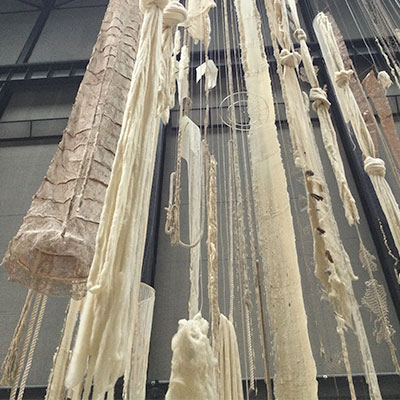

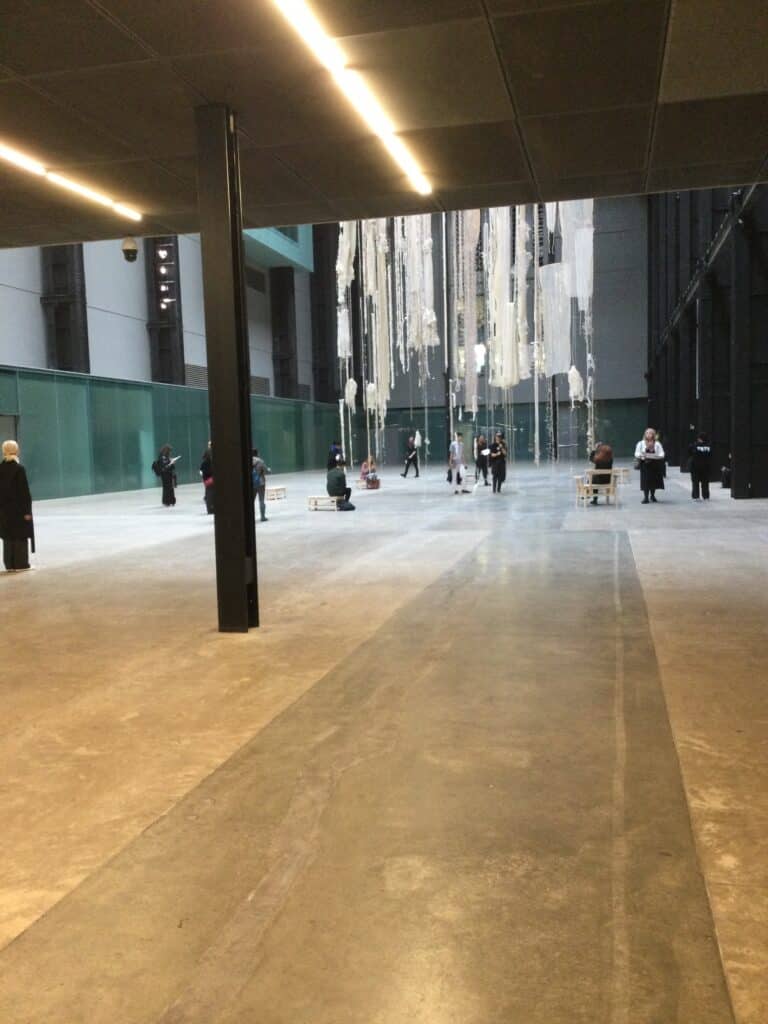
If the tallest known tree in the Amazon rainforest—an 88-metre tall Dinizia excelsa—were planted in Tate Modern’s Turbine Hall, a roof hole would be required to allow the tree to soar a further 60 metres. Climate change and the history and fate of the Amazon rainforest are elemental to the art of Cecilia Vicuña. ‘The Earth is a brain forest,’ she says, and a resource we squander at our peril. Her 2022 site-specific work for the Turbine Hall – Tate Modern’s immense roofed “boulevard” in the former industrial building—sees her create two 28-metre tall fibre-based quipu. Like the Dinizia tree, her quipu are ‘canopy-emergent’; they soar literally and figuratively above all else.
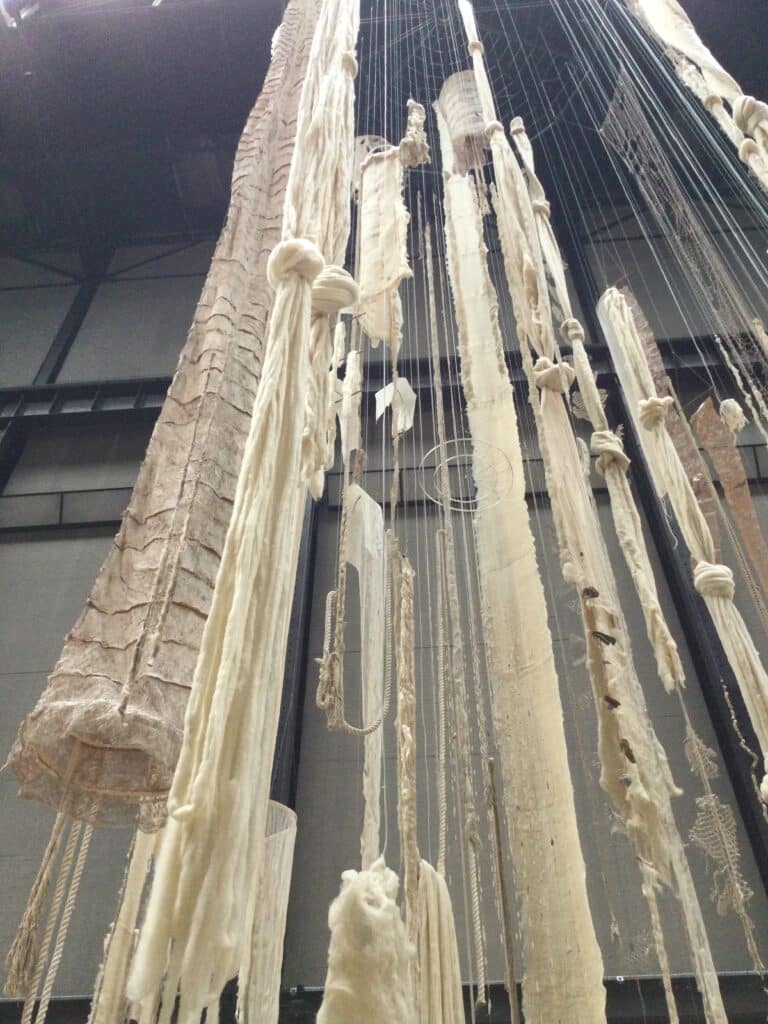
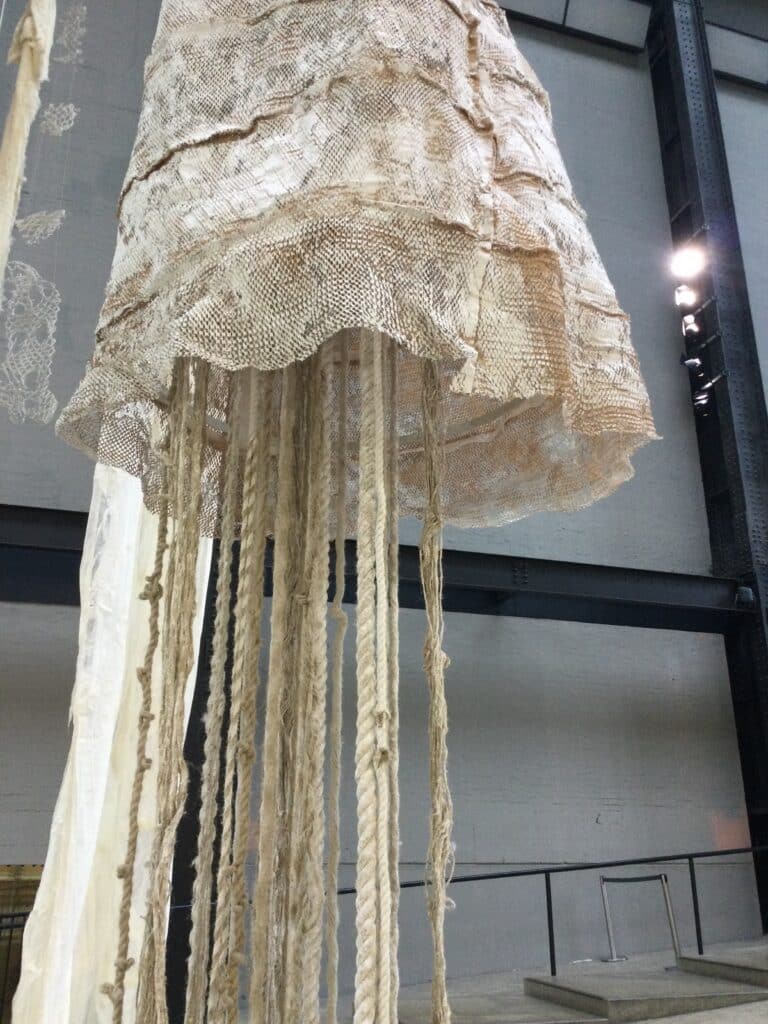
Unlike Vicuña’s boldly coloured quipu exhibited at the Guggenheim New York in June 2022, Brain Forest Quipu are shades of bleached bones, symbolic of ‘mourning’ as if to suggest what remains after humanity bleeds the rainforest of its resources. Ethereal yet substantial, Vicuña’s quipu pair are described by the artist as ‘mother and child’. Each incorporates interconnected yet independent weaves, some so gauzy they sway with the slightest shift in air currents, as well as found objects ‘mudlarked’ from the foreshore of the Thames river.
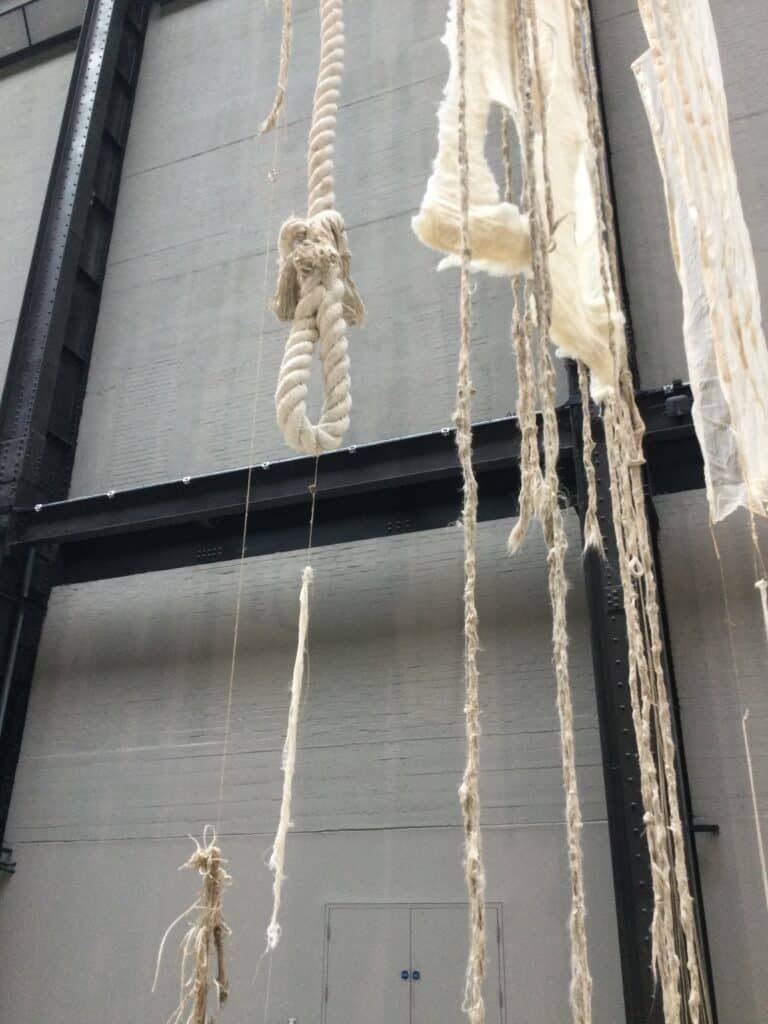
The word ‘monumental’ is used in various reviews of Vicuña’s Tate installation. The definition of monumental—’large, solid, imposing’—isn’t accurate for Vicuña’s work, but the word’s obsolete definition—’token or reminder’—is. Vicuña has spent more than half a century collecting ‘tokens’ of waste and organic and inorganic found materials to create small sculptures she calls precario. She often adds these materials to her fibre-based quipu.
The prevalence and significance of knots in her quipu relate to an ancient Andean mnemonic device—a system of knotted cords to aid memory retention and recovery. Camelid fibres (alpaca, llama, guanaco) were spun by Andean cultures into cords. The cords were looped over a central cord. Each cord—often with secondary ‘tree’ branches—was then tied with coded knots. Different cord dimensions and colours aided pattern recognition. The system was used to remember or share narratives and numerical counts. Quipu could be transported via a relay of chasquis (running messengers). Each man akin to a quipu knot—an essential part of a collective whole which allowed ideas to spread throughout thousands of kilometres of the Andean mountain range.
Most surviving historic quipu are not fully decipherable. Their meaning is lost. The meaning behind Cecilia Vicuña’s quipu is loud, insistent, intense and urgent. Vicuña’s sculptures speak softly like the artist herself, but we can no longer ignore her message to be careful stewards of Earth’s ‘brain forest’.