
To be truly knowledgeable about design, you need to understand its origins, an idea that seems particularly relevant to rugs. Here we discuss the Polonaise, new versions of which have been in focus recently.
While there may be some confusion in the naming of these rugs, there is not and never has been any such uncertainty about the appeal of the luxurious silk and metal thread carpets. Made in workshops in central Persia in the 17th century, these carpets were commissioned for and much sought after by European nobility who considered them to be the height of eastern splendour and exotic luxury. Polonaise carpets entered the collections of the most powerful families in Europe and became icons of power and patronage via depictions in paintings and their use as symbols of prestige. At the same time, these rugs also represented the successful export and display of the power and majesty of the Safavid Shah Abbas.
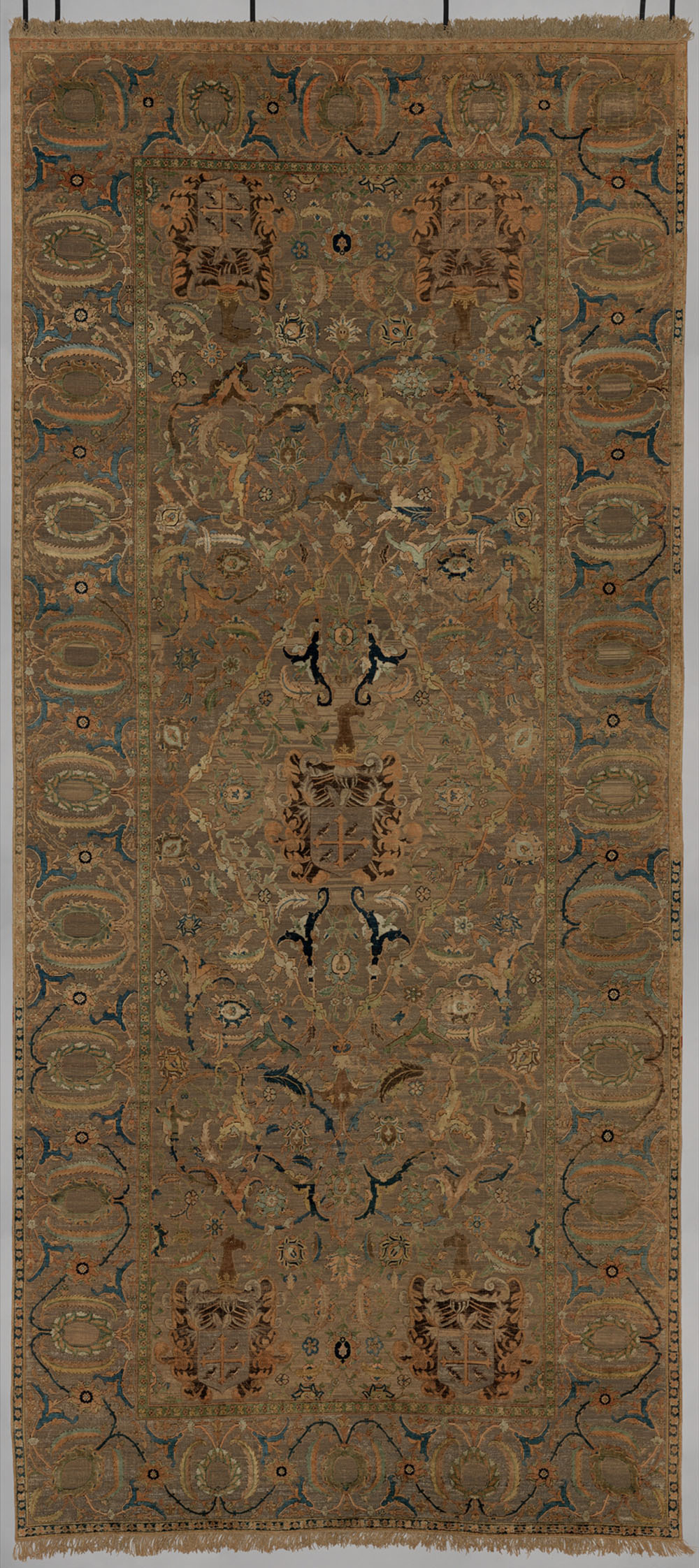
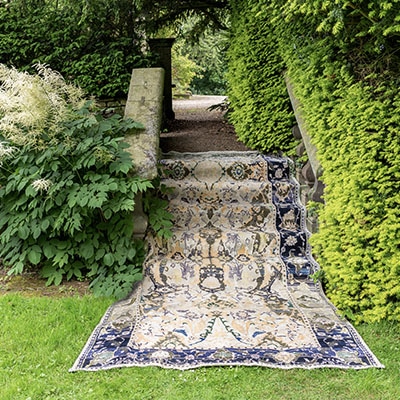
The Czartoryski Polonaise Carpet, central Persia, 17th century. Silk pile brocaded with metal-wrapped thread; 2.17 x 4.86 m (7’ 2” x 15’ 2”). Metropolitan Museum of Art, Gift of John D. Rockefeller Jr., and Harris Brisbane Dick Fund, by exchange, 1945, 45.106
It was mistakenly thought that these carpets were made in Poland, when in 1878 the Polish Prince Czartoryski showed a gold-covered carpet at the Paris World Fair with his princely coat of arms included. Since there were Polish workshops making silk and metal thread sashes worn by the nobility exhibiting Persianate designs, it was assumed that a workshop in Slucz, Volhynia, which was staffed in the 18th century by Persian weavers, had also made these carpets. However, records later showed that these rugs were those ordered by Polish ruler Sigismund III Vasa, who in 1601 commissioned the Armenian merchant Muratovitz to travel to Iran to buy carpets with a special request to include his coat of arms.
The qualities that attracted admiration at the time were the silk pile and gold and silver thread ground with their shimmer and shine, yet it was the technical virtuosity of the weavers and designers that achieved these effects, revolutionising the rug-weaving industry. The aesthetic effect of the different materials used to articulate aspects of the pattern, to enhance the layers of design and to enrich the flow of the interlaced vines and tendrils became a point of reference for many later Persian classic rug designs.
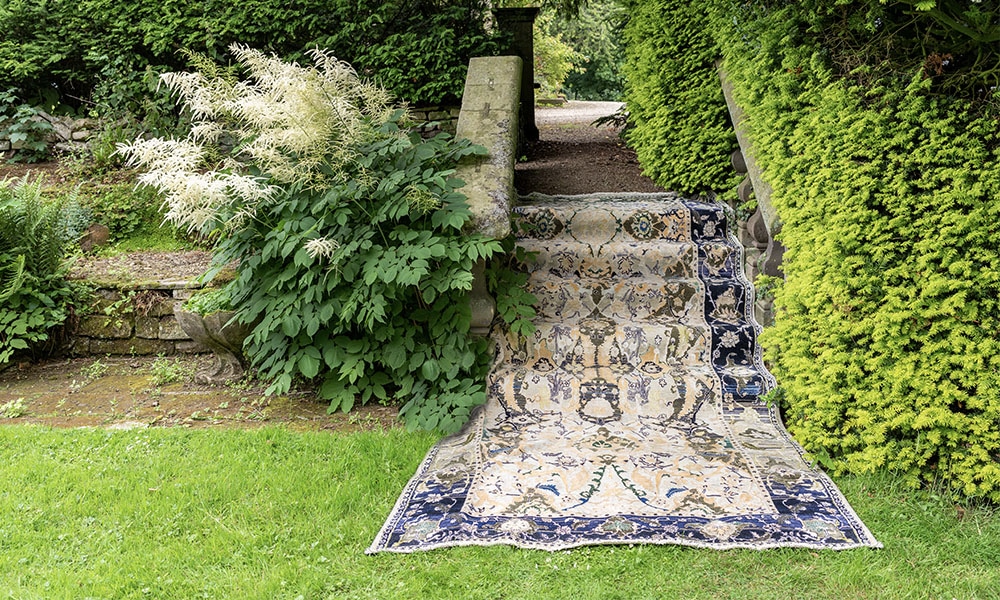
Polonaise No. 09, 17th Century Modern Collection, Knots Rugs
These qualities have not escaped the notice of a new crop of leading rug designers, with at least two companies having recently launched new Polonaise-inspired rug collections. German firm Jan Kath and London-based Knots Rugs have redrafted the patterns to fit contemporary room sizes, and they have dealt with the transition between the different material qualities of the originals in individual ways, yet both manage to capture movement and depth in their use of different textures, materials and pile heights. What is important in reproducing old rug designs successfully is that the intent of the original is understood, considered and interpreted rather than a design simply copied. Both Jan Kath and Knots Rugs have thoroughly taken in the qualities, material and aesthetic embodied by the original carpets and have managed to replicate their finest qualities, bringing that sense of awe and conspicuous luxury to a new appreciative audience.
This article originally appeared in COVER 54, Spring 2019
.