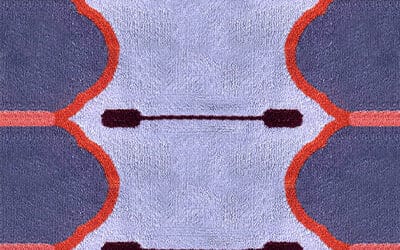

Young creative Mahjabin Ilkhanipour, who founded Kerman based handmade rug company Moon Killim in 2016, talks to Lucy Upward about her maker’s journey and proves there is a new wave of young Iranian designers ready to transform our notions of the Persian rug in this article from COVER 58.
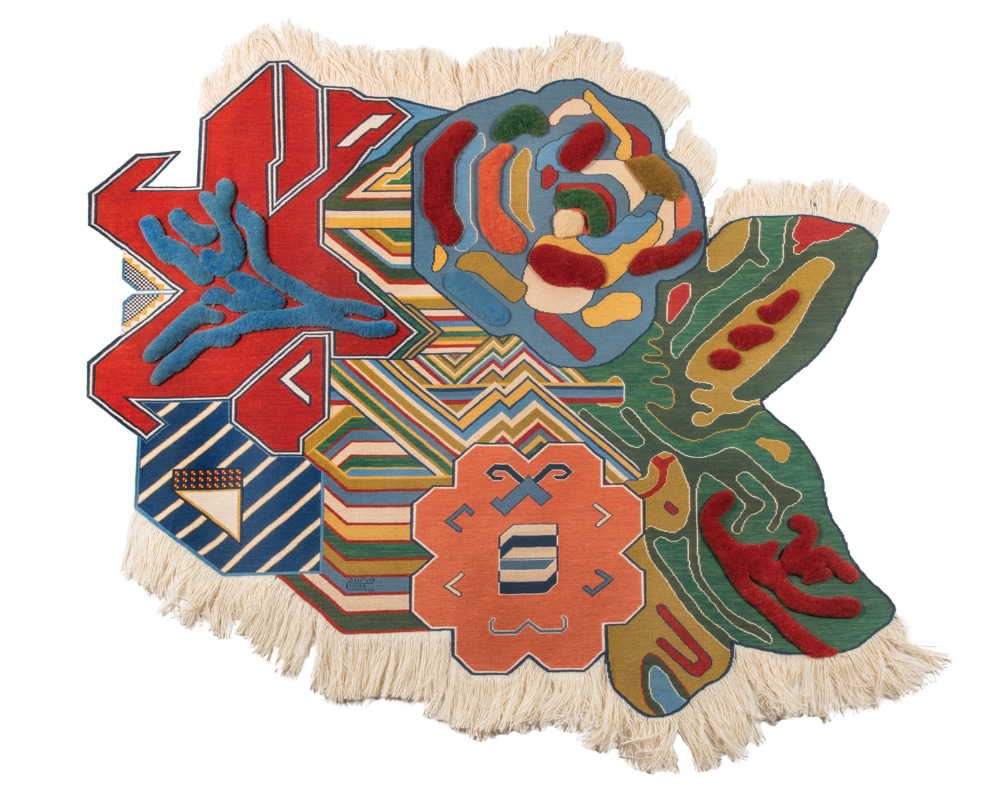
Pleasantly persistent’ is how successful entrepreneurs often describe the strategy that got their foot in the door of new opportunities. It is a term that could definitely be applied to Iranian entrepreneur Mahjabin Ilkhanipour, CEO of the handmade rug company Moon Killim, who first got in touch with me a year ago and who came to find me during her visit to Domotex Hannover in January. There, we sat and chatted about the production she runs at her workshop in Sirjan, Kerman province, Iran.
Ilkhanipour graduated from Payame Noor University with a BA in graphic design—initially working for an advertising agency in Tehran—and an MA in Art Research. She followed academic study with a weaving course in Sirjan, an elementary course in natural dyeing in Kerman, and an advanced course in one of Iran’s well-known dyers’ labs. She started her company Moon Killim in 2016. Her perfect English is a result of time spent in England.
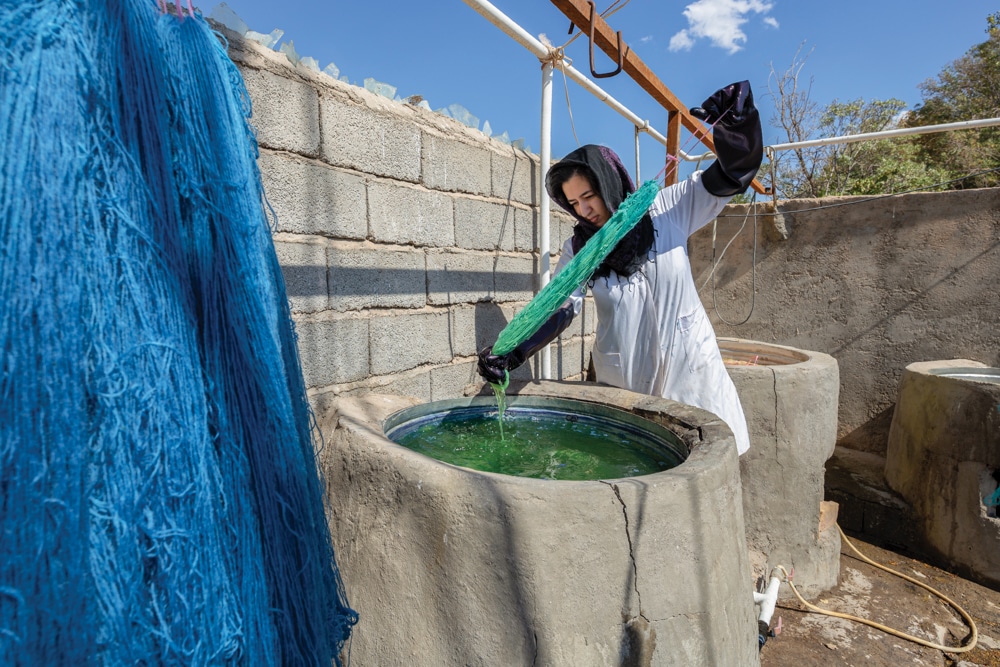
‘I’m from the Afshar tribe,’ she explains, ‘my ancestors were moved to southeast Iran and brought their art of weaving with them. I’ve loved watching carpets and kilims being woven since childhood.’ In 2017, Sirjan was designated a World Craft City—an award affiliated with UNESCO in recognition of Sirjan’s unique style of kilim weaving. ‘During my MA research projects I visited villages around Sirjan and talked to the weavers. I talked with my husband about starting a kilim weaving business. He threw himself behind my idea.’
Although Sirjan weavers traditionally work from home, Ilkhanipour and her husband opened a workshop to control production and try to stem inevitable copying (Iran doesn’t recognise copyright). Ilkhanipour creates her own interpretations of traditional Afshar designs. ‘At first the weavers were confused. “Why are you giving us these designs? Will anyone like it? Can you sell these? We don’t know if we can do that?”, but when the rugs were finished I could see they kind of liked them.’ Ilkhanipour smiles as she remembers how her weavers changed. ‘Now they tell me, “give us a new design, we want to see how it turns out!”.’ As work increases they sometimes employ home weavers near the workshop, but all weavings are consistent with her values, including consistent high quality.
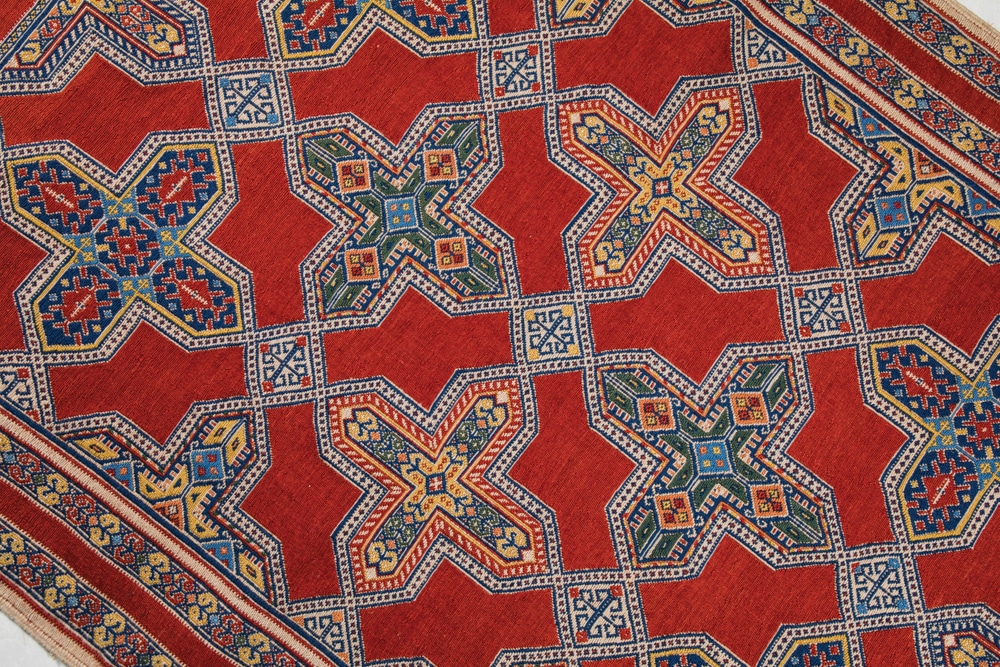
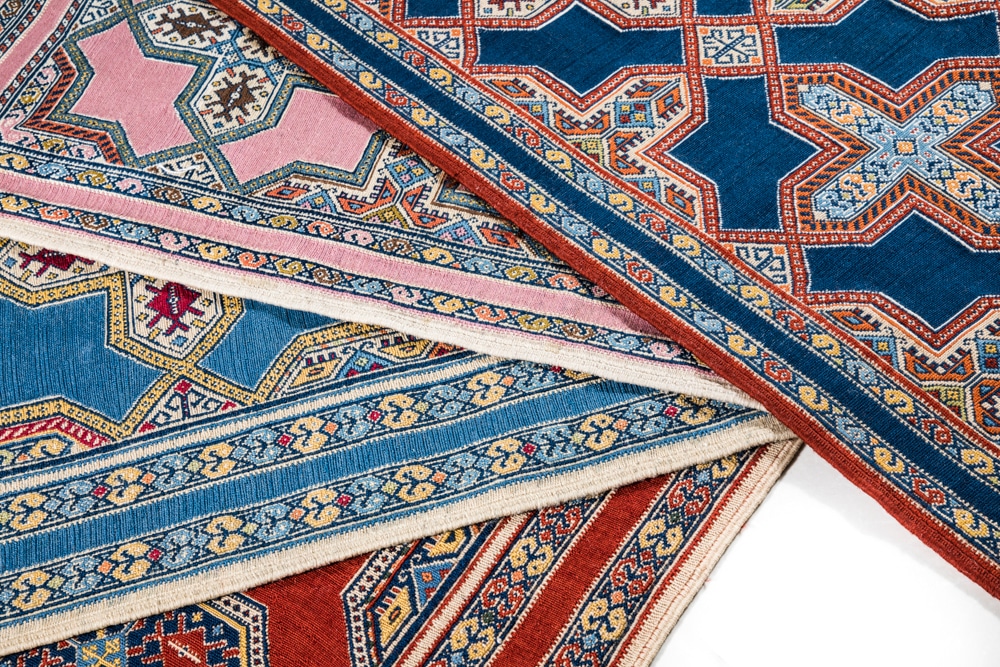
Moon Killim represents Ilkhanipour’s contemporary approach to heritage weaving. ‘I see myself as creating a new generation of Afshar tribal designs,’ she explains. ‘The Persian rug is full of mysteries and the more you get to know it the more you will be enchanted by its beauty and the hidden story behind every little detail.’ She uses plantbased dyes that she grows and dyes Persian or merino wool in outdoor vats. Her and her husband grow madder and pomegranate in the workshop garden, source walnuts locally, and in spring pick prangos, and in the summer they collect myrtus communis from the mountains around Sirjan. Her kilim technique combines Shirikipich (a special type of weaving done in Sirjan) and conventional rug weaving. ‘You need to weave a thinner weft through the rug,’ she says. Sirjan kilims have weft on top of the knots and rugs have two wefts: one thick weft and on top of that a thinner weft.
Ilkhanipour currently sells her rugs within Iran, while pieces like Musa and the Moon are made to be viewed as pieces of art. She has previously exhibited in Iran and China but has plans to show work in Europe. I predict her polite persistence will go far with a global audience hungry for original, artistic, handmade, high-quality work.

.